
Company Overview
Jio Platforms Limited (JPL), incorporated in November 2019, is a technology platform company that combines digital connectivity with consumer applications and enterprise technology solutions. Its key operating subsidiary, Reliance Jio Infocomm Limited (RJIL), provides mobile and fixed broadband services across India.
As of June 30, 2026, Jio served 533.3 million customers, with its wireless broadband network covering more than 99% of India’s population. The company held a 49.78% share of India’s wireless broadband market and has built a strong position in 4G, 5G and home broadband services.
Jio’s business extends beyond telecom connectivity into digital entertainment, gaming, music, cloud storage, virtual computing, artificial intelligence and enterprise solutions. Its consumer offerings include JioTV+, JioSaavn, JioGames, JioAICloud and JioPC. The enterprise business provides cloud and security services, Internet of Things (IoT) solutions, private 5G networks, managed services and enterprise AI.
The company has also developed its own technology capabilities, including its 5G network stack, network automation systems and JioBrain, its proprietary AI engine. As of June 2026, Jio and its subsidiaries had filed 7,220 patent applications, supported by a dedicated digital product and technology workforce.
Jio’s key advantage lies in its ability to use its large connectivity base to distribute additional digital services at relatively low incremental customer acquisition costs. Over time, growth is expected to come not only from adding subscribers but also from increasing average revenue per user, expanding home broadband and monetising its wider digital ecosystem.
Promoters & Shareholding
Shareholding
| Shareholding | Pre Issue | Post Issue |
| Reliance Industries Limited | 66.43% | 64.48% |
| Other shareholders | 33.57% | 35.52% |
| Total | 100.00% | 100.00% |
Reliance Industries Limited is the promoter of Jio Platforms. The IPO is entirely a fresh issue, with no offer for sale by existing shareholders.
Public Issue Details
- Offer Type: Fresh Issue
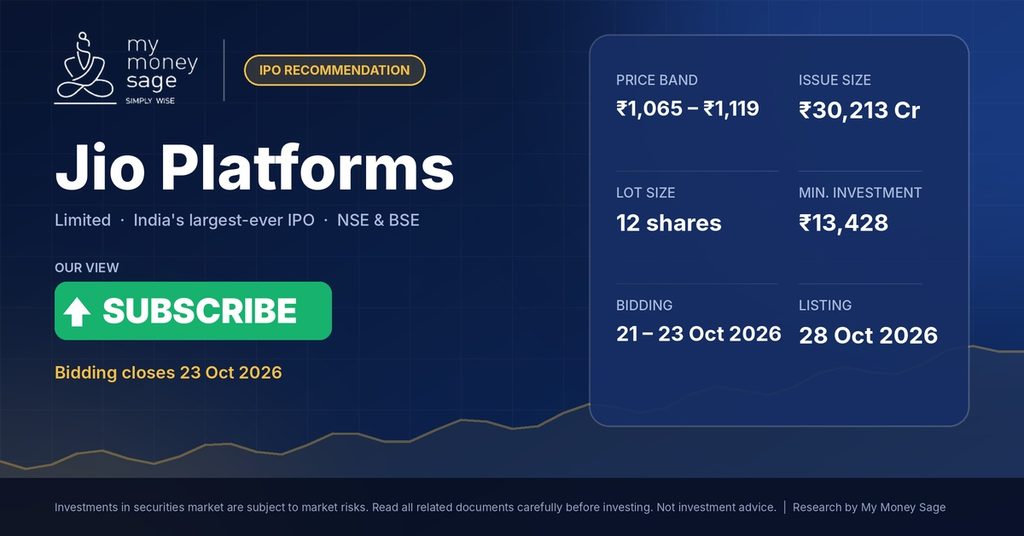
- Issue Size: ₹30,213 crore
- Price Band: ₹1,065 to ₹1,119 per share
- Face Value: ₹10 per share
- Post Issue Market Capitalisation: Approximately ₹9.81 lakh crore to ₹10.30 lakh crore
- Offer Period: October 21 to October 23, 2026
- Tentative Listing Date: October 28, 2026
- Issue Allocation: QIB up to 50%, NII at least 15%, Retail at least 35%
- Lot Size: 12 shares and multiples thereof
- Promoter Holding Post Issue: 64.48%
At the upper price band of ₹1,119, a retail application for one lot requires an investment of ₹13,428, before any applicable charges.
Objects of the Offer
Jio Platforms proposes to utilise the IPO proceeds primarily to reduce borrowings at Reliance Jio Infocomm Limited.
Repayment of Outstanding Borrowings: ₹27,500 crore
The company plans to use ₹27,500 crore towards prepayment or repayment of certain outstanding borrowings of RJIL. This is expected to reduce finance costs, improve the balance sheet and provide greater financial flexibility for future network investments and business expansion.
The remaining proceeds, after issue related expenses and the proposed debt repayment, will be available in accordance with the final offer document and applicable requirements.
Business Strengths and Growth Drivers
1. Strong Market Position and Scale
Jio has established a leading position in India’s wireless broadband market, with 533.3 million customers and a network covering more than 99% of the population.
Its scale supports lower operating costs, broad distribution and the ability to introduce new services to an established customer base. Monthly customer churn stood at 1.61% in Q1 FY27, indicating relatively strong customer retention.
2. Scope for Improvement in ARPU
Jio’s average revenue per user (ARPU) increased from ₹181.7 in FY24 to ₹214.0 in FY26 and ₹215.6 in Q1 FY27. However, this remains below Bharti Airtel’s reported ARPU of approximately ₹263.9.
This gap provides scope for revenue growth through tariff increases, migration to higher value plans, greater 5G adoption and the addition of digital services. However, the timing and extent of tariff increases will depend on competitive conditions and customer response.
3. Growth in Data Consumption and 5G
Monthly data consumption per customer increased from 28.7 GB in FY24 to 42.3 GB in FY26 and 43.7 GB in Q1 FY27. Jio had 284.9 million 5G customers as of June 2026.
Rising data usage supports demand for network capacity and creates opportunities to improve monetisation over time. Jio’s spectrum holdings and in house network technology provide an advantage in managing this growth.
4. Home Broadband Expansion
Jio had 28.6 million fixed broadband customers as of June 2026, including services delivered through JioFiber and JioAirFiber. It held a 43.32% share of India’s fixed broadband market and accounted for 61.73% of industry net additions in Q1 FY27.
With fixed broadband penetration in India still relatively low, expansion into homes and small businesses offers a significant opportunity. Bundling broadband with entertainment, cloud and other digital services could also improve customer retention and revenue per household.
5. Digital Services and Enterprise Technology
Jio is expanding beyond connectivity through digital subscriptions, cloud services, IoT, managed security, private 5G and AI solutions. Revenue from digital services grew 36% to ₹16,167 crore in FY26, according to the provided research.
Its proprietary technology platform and large distribution base could support further growth in enterprise solutions and digital services. International technology partnerships also offer potential opportunities, although the scale and timing of these contributions remain uncertain.
Pros
- Leading position in India’s wireless broadband market with 533.3 million customers and more than 99% population coverage.
- Strong revenue and earnings growth, supported by increasing data consumption, customer additions and improving ARPU.
- Large spectrum holdings and proprietary 4G and 5G technology, supporting network capacity and operating efficiency.
- Significant scope to improve ARPU, which remains below Bharti Airtel’s, through tariff increases and migration to higher value plans.
- Growing home broadband business, with 28.6 million customers and a 43.32% share of India’s fixed broadband market.
- Digital services revenue grew 36% to ₹16,167 crore in FY26, providing an additional growth avenue beyond connectivity.
- Strong cash generation and improving free cash flow as network investment requirements moderate.
- Proposed repayment of ₹27,500 crore of borrowings from IPO proceeds is expected to strengthen the balance sheet and reduce finance costs.
Risks
- Tariff Increase Uncertainty: Future earnings growth depends partly on the timing and extent of tariff hikes. Delays or limited increases could affect revenue and profitability.
- High Capital Requirements: Spectrum payments, network expansion, technology upgrades and maintenance will continue to require substantial investment.
- Intense Competition: Bharti Airtel remains a strong competitor, while Vodafone Idea’s recovery and the entry of satellite broadband providers could influence pricing and market share.
- Reliance on Distribution Channels: Reliance Retail accounted for the distribution of all prepaid plans, which contributed around 77.1% of FY26 revenue. This creates a significant dependence on a group linked distribution channel.
- Regulatory Risk: Telecom tariffs, spectrum allocation, licence fees and government policies can affect operating costs and profitability.
- Related Party Dependence: Reliance on group linked infrastructure and distribution arrangements requires monitoring of commercial terms and governance.
Industry Outlook
India’s telecom sector is expected to benefit from increasing data consumption, wider 5G adoption and the gradual migration of remaining 2G users to mobile broadband. Around 261 million Indians still use 2G services, while rural broadband penetration remains relatively low. This provides scope for further customer additions, particularly for operators with extensive networks and affordable offerings.
Data consumption is also expected to rise significantly. Industry estimates cited in the provided research indicate that monthly data usage per customer could increase from around 26.7 GB to 59.2 GB by FY31, supported by video streaming, gaming, digital payments and growing AI usage. Jio customers were already consuming 43.7 GB per month as of Q1 FY27.
Home broadband is another important growth opportunity. Fixed broadband penetration in India was around 21% in FY26 and is projected to reach approximately 46% by FY31. Fibre and fixed wireless access services can help connect more households without requiring fibre infrastructure to every property. This creates opportunities for JioFiber, JioAirFiber and bundled digital services.
The industry also has scope to improve revenue per user. Indian data prices remain low compared with several international markets, while operators need sufficient returns to fund network investments. This supports the possibility of further tariff increases, although the timing and extent will depend on competition and affordability.
Beyond consumer connectivity, demand for cloud services, private 5G networks, IoT, cybersecurity and enterprise AI could provide additional growth avenues. Jio’s technology platform and existing customer base give it an advantage in distributing these services.
Overall, the industry’s long term outlook remains favourable, supported by rising data usage, broader broadband adoption and increasing digitalisation. However, the pace of tariff increases, capital expenditure requirements and competitive intensity will remain important factors in determining how effectively operators convert this growth into higher earnings.
Financial Snapshot (₹ Crores)
| Particulars | FY24 | FY25 | FY26 | Q1 FY27 |
| Revenue | 1,09,558 | 1,28,218 | 1,46,885 | 39,173 |
| Revenue Growth | – | 17.0% | 14.6% | 11.8% |
| EBITDA | 54,959 | 64,170 | 76,255 | 20,865 |
| EBITDA Margin | 50.16% | 50.05% | 51.91% | 53.26% |
| PAT | 21,423 | 26,109 | 30,049 | 7,764 |
| PAT Margin | 19.55% | 20.36% | 20.46% | 19.82% |
| Diluted EPS (₹) | 23.93 | 29.17 | 33.59 | 8.68 |
| RoCE | 12.83% | 12.50% | 10.76% | – |
| RoNW | 8.02% | 8.97% | 9.42% | – |
Valuation
At the upper price band of ₹1,119, Jio Platforms is valued at approximately 33.3 times FY26 earnings, with a post issue market capitalisation of around ₹10.30 lakh crore. On a price to book basis, the valuation stands at approximately 3.0 times, while EV to EBITDA is around 13.2 times for FY26, or 14.8 times after including deferred spectrum dues and leases.
Compared with Bharti Airtel, which trades at approximately 40.7 times earnings and 7.4 times book value based on the supplied research, Jio is available at a discount despite having a larger Indian customer base, faster FY26 EBITDA growth and a higher reported PAT margin. However, Bharti Airtel continues to report better return ratios and higher ARPU, reflecting stronger customer monetisation.
Jio’s valuation therefore appears reasonable relative to its closest listed peer, provided it can sustain earnings growth through tariff increases, greater 5G adoption, home broadband expansion and digital services. However, the valuation is not inexpensive in absolute terms, and returns will depend on the company’s ability to convert its scale and rising data consumption into consistent earnings growth.
Our View
Jio Platforms offers a strong long term investment opportunity, backed by its leading position in India’s telecom sector, large customer base and expanding digital ecosystem. Consistent revenue and earnings growth, rising data consumption and scope for ARPU improvement provide multiple growth drivers. The company’s improving cash generation and the proposed repayment of ₹27,500 crore of borrowings are additional positives.
At the upper price band, Jio is valued at a discount to Bharti Airtel on earnings and book value multiples, offering a reasonable entry point relative to its listed peer. However, tariff increases, competitive intensity, regulatory changes and ongoing network investment remain key risks.
Considering its market position, growth potential and relative valuation, we recommend the Jio Platforms IPO for investors with a long term investment horizon. Investors should be prepared for market volatility, with returns depending on sustained earnings growth and the company’s ability to improve monetisation over time.
Investors are advised to consult their financial advisors before making any investment decisions. This view does not constitute investment advice.
If you do not have one visit mymoneysage.in
